Not finished at all!
The most fundamental of the economic sectors, the primary sector is composed of activities related to the extraction and production of natural resources. These include agriculture, logging, fishing, and mining. Traditionally, work in the primary sector has required relatively low levels of formal education or specialised skills. As a result, such jobs have often been lower-paid and less sought after compared to those in secondary and tertiary industries.
Nowadays, most primary-sector activities in the developed world rely heavily on mechanisation, automation, and economies of scale. Farmers use tractors and large combine harvesters to cultivate vast areas of land; mining operations employ massive drills and haul trucks in expansive strip mines; and industrial fishing fleets deploy trawler nets capable of harvesting thousands of fish in a single outing. These technologies increase productivity and reduce the need for labour.
The resource curse
Resource abundance does not necessarily lead to economic prosperity. According to Frankel (2010), resource-rich economies frequently fail to outperform resource-poor ones due to factors such as commodity price volatility, weak political institutions, and the crowding out of non-resource sectors like manufacturing and services. This phenomenon is commonly referred to as the resource curse.
See Frankel’s working paper published by the National Bureau of Economic Research (NBER):
https://www.nber.org/system/files/working_papers/w15836/w15836.pdfAccordi
Industrial Agriculture
I made a post on agriculture, check it out if you want to know more. But, this will focus mostly on the economic stuff related to agriculture.
Agriculture is the beginning of civilisation, and you need it as long as you aren’t a robot. Modern industrial agriculture is reliant on chemical fertilisers, pesticides, herbicides, genetically modified high-yield crops, selectively bred livestock, and extensive mechanisation.
In the midst of this, the modern corporation plays an important role. For example, Monsanto (now part of Bayer) was a major American agribusiness firm known for producing herbicides and genetically modified seeds. The company was highly controversial and faced numerous lawsuits related to environmental and health concerns. Such corporate dominance should be an important consideration in worldbuilding, particularly in Scifi and dystopia.
Many governments impose tariffs and provide subsidies to protect domestic agriculture. This is largely motivated by concerns over food security. A country that relies entirely on food imports may face severe shortages during wars, trade disruptions, or global crises. For instance, the United States government spends billions of dollars annually subsidising corn and soybean farmers.
This may suprise you: but in North America, most farmland is owned by individuals or families rather than corporations. Nevertheless, corporations often control nearly every other part of the agricultural supply chain, including seeds, fertilisers, machinery, processing facilities, logistics, and retail distribution. Maybe in your world, the corporation takes a further step. In Cyberpunk 2077, for example, the Biotechnica Flats are made up of by synthetic protein farms owned entirely Biotechnica.
Modern agriculture relies on a small number of genetically uniform crop strains, making food systems highly vulnerable to disease, pests, and environmental disasters. Heavy dependence on pesticides further increases systemic risk. In a worldbuilding context, this opens the possibility of crop failures caused by bioterrorism, covert military operations, or ecological collapse.
Modern Livestock are selectively bred for productivity and efficiency, making them genetically uniform as well. Factory farming environments often promote disease spread and raise serious ethical concerns regarding animal welfare. Practices such as debeaking, in which poultry have their beaks trimmed to prevent cannibalism, reflect the extreme conditions of industrial livestock production. All in all however, this is the way the world meets the massive consumer demand for meat.
Commercial/Industrial Fishing
Below are methods to catch fish
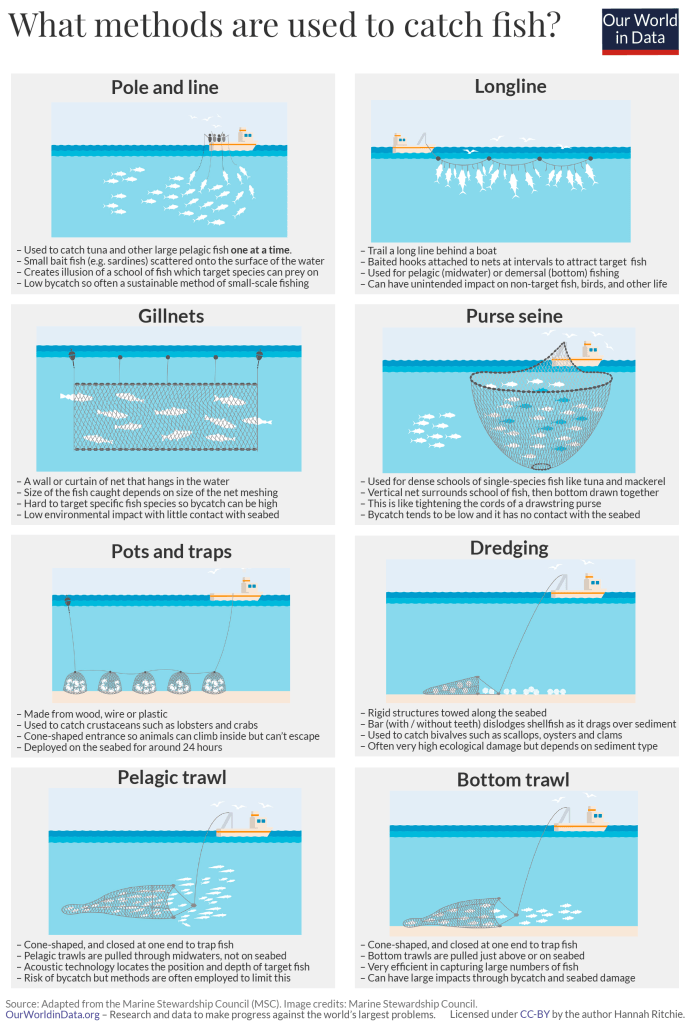
Industrial fishing is dominated by large fleets capable of operating across entire oceans. For example, Chinese fishing fleets routinely operate off the coasts of South America and Africa. Once caught, fish are processed either onboard ships or at coastal facilities, then sold directly or converted into products such as fishcakes, surimi, or imitation crab meat. Fish markets are often located near ports, while processed products are distributed through supply chains.
The greatest issue facing industrial fishing is environmental damage. Bottom trawling damages seabed ecosystems, large amounts of bycatch are discarded, and overfishing reduces global fish populations. These practices threaten long-term sustainability and can destabilise coastal economies that depend on marine resources.
Mining
I know that as a child, Steve (Jack Black) yearned for the mines. However, any modern mining venture (in the developed world at least) would never think of using a child. Modern mining is a highly technical and capital-intensive industry. While mining once relied heavily on manual labour, contemporary operations generally require skilled workers capable of operating complex machinery and computer systems. Mines are typically owned and controlled directly by large corporations.
Here are a couple mining techniques
Artisional Mining
Artisanal mining refers to small-scale, informal mining operations, often found in developing countries. The Equipment used ranges from basic tools to small water pumps, and regulation can be less stringent as it is informal.
Surface/Strip Mining
Surface mining involves extracting resources from large open pits that can span hundreds of metres in width. While highly efficient, this method causes extensive environmental damage.
- Open-pit mining is one of the most common forms of surface mining. It involves digging a large, open excavation in the ground that expands both outward and downward. The pit is carved into a series of stepped levels, known as benches, which allow heavy machinery to access the ore safely. Open-pit mining is widely used for metals such as copper, iron ore, gold, and for diamonds. While highly productive and cost-effective, it leaves behind massive pits and waste rock piles that can remain visible for centuries.
- Strip mining: Strip mining is used when mineral deposits lie in long, horizontal seams close to the surface. Instead of digging a deep pit, miners remove the overlying soil and rock in long strips to expose the resource beneath, often coal. As mining progresses, overburden from new strips is placed into previously mined areas. Although efficient, strip mining can severely damage ecosystems if land reclamation is poorly managed.
- Mountaintop removal mining: Entire mountaintops are blasted away to reach coal seams, and the removed material is often deposited into nearby valleys. This method allows access to resources that would otherwise be difficult to mine, but it permanently destroys landscapes, alters river systems, and has significant social and environmental consequences.
- Quarrying: A surface mining method focused on extracting stone and aggregate materials such as limestone, granite, marble, sand, and gravel. Quarries are usually shallow and wide, and their products are important for everything ranging from construction to cement production.
- Placer mining: Placer mining extracts valuable minerals from loose sediments, typically found in riverbeds, floodplains, or coastal deposits. It relies on the fact that heavier minerals such as gold or tin settle differently from lighter material. Historically important and technologically simple, placer mining nevertheless disrupts waterways, increases sedimentation, and damages aquatic ecosystems.
- Highwall mining: Highwall mining is a hybrid surface method used when traditional strip mining is no longer economical. After a strip mine reaches its practical limit, machines extract additional resources horizontally from the exposed rock face. This extends the life of a mine while limiting further surface disturbance, though environmental impacts remain significant.
Underground Mining
Underground mining accesses deep mineral deposits through tunnels and shafts. It is more expensive and dangerous than surface mining but is often necessary when surface deposits are depleted and some resources may not exist on the surface.
Logging and Forestry
Logging and forestry involve the extraction and management of timber resources. The modern logging industry relies heavily on machinary to cut down large trees and transport them. Additionally, logging often leads to heavy deforestation unless there are policies and practices to regrow trees.
 Fishy Worldbuilding
Leave a comment